Est. 1610
Our History
Over 400 years of worship, witness, and service in Hampton.
Settlement Begins
English settlers established a community and church on the tip of the peninsula in 1610, three years after the colonization of Jamestown. A small group of civilians and soldiers moved to the shores of Hampton Roads to escape the famine and disease which had decimated the residents of Jamestown, finding a more congenial environment among the Kecoughtan Indians. The first minister was the Rev. William Mease, appointed by the Bishop of London to lead the church at Kecoughtan.
First Parish Site
Excavations in the Church Creek area of Hampton indicate the earliest English settlements were near present-day LaSalle and Chesapeake Avenues, where tradition holds that services of the parish were held. A historical marker on LaSalle Avenue commemorates this first site.
Elizabeth City Named
"Kecoughtan" was renamed "Elizabeth City" in honor of the daughter of King James I, though the Indian name continued in popular use for another century. The settlement was later renamed "Southampton" to honor the Earl who was a major stockholder in the Virginia Company — in time shortened to "Hampton."
Second Parish Site
By 1623 the settlement had re-established itself east of Hampton River, where the second church of Elizabeth City Parish was built on a site now located on the grounds of Hampton University. Its foundations were discovered in 1910. Artifacts found during excavation are on display in the parish house museum.
Third Parish Site
The third building was constructed more than a mile to the west at "Westwoods Town Quarter," reflecting growth on the west side of Hampton River. The site off West Pembroke Avenue features a historical marker, building foundations outlined by bricks, and several 17th and 18th century gravestones. The parish retains ownership of both the second and third sites.
Present Church Built
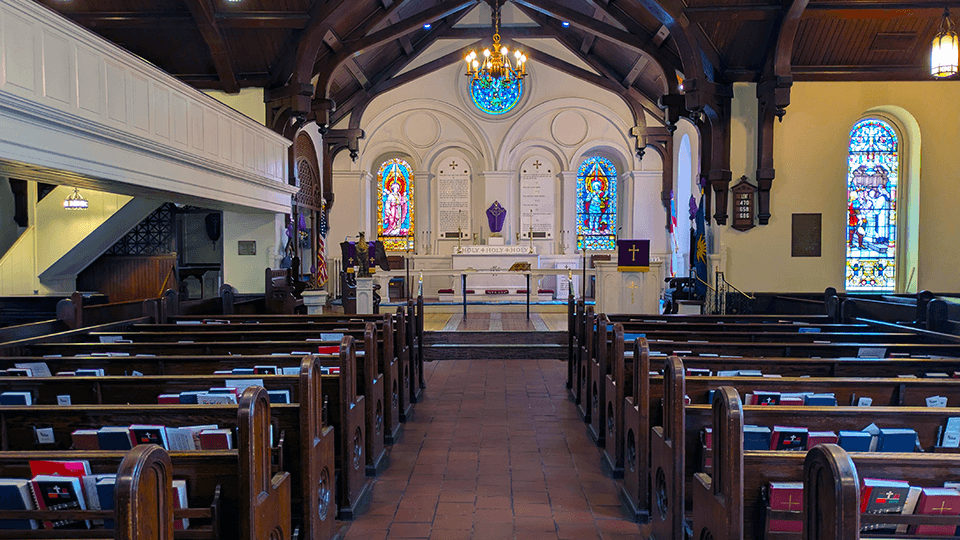
Henry Cary, Jr. of Williamsburg completed the current cruciform building in 1728, constructed on half an acre on the outskirts of Hampton closer to the busy port. The 1728 walls are of Flemish Bond brickwork with superbly glazed headers — among the most handsome in Virginia. A belfry was added to the west front in 1762.
Consecrated as St. John's
After a period of decline following the Revolutionary War, funds were raised in 1825 to restore the church. The Rt. Rev. Richard Channing Moore, Bishop of Virginia, consecrated the restored Elizabeth City Parish church in 1830 under its new name, St. John's.
The Church Burns
On August 7, 1861, Hamptonians set fire to their homes, businesses, and the church to keep the town from Federal hands. The great bell was destroyed, and only the blackened walls remained when Union soldiers camped in the churchyard. As a result, St. John's is the only surviving colonial structure in downtown Hampton.
The Pocahontas Window
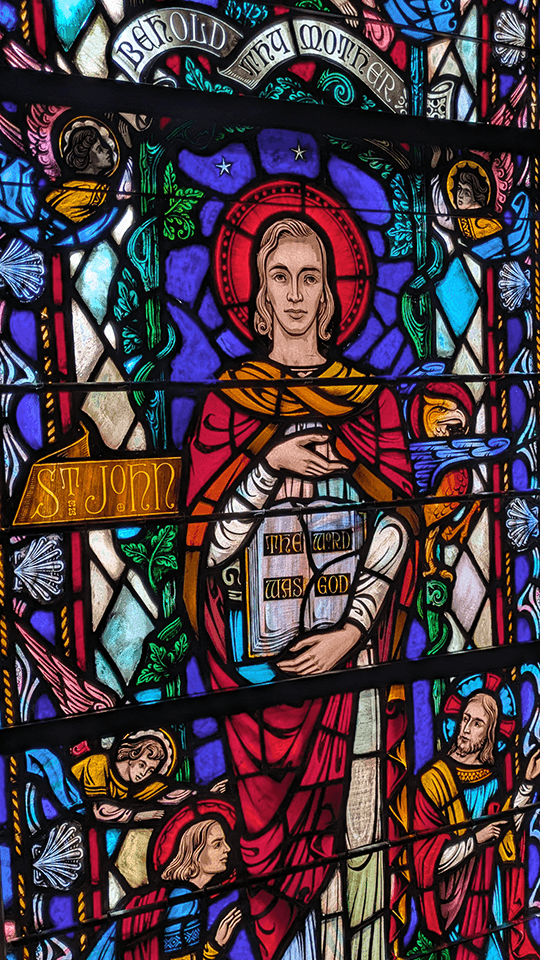
The Pocahontas window was given in 1887, in part by Native American students from the Hampton Normal and Agricultural Institute (now Hampton University), who participated in the life of this parish. Also notable is the small north wall window bearing the seal of the Society for the Propagation of the Gospel in Foreign Parts, installed around 1903.
Skinner Organ Installed
A 1926 Skinner manual tracker organ was installed left of the altar. In 1981, construction began to place a new organ in the west gallery (built 1957) to replace the Skinner organ, which had been destroyed by water. The current Parson's organ was installed in the gallery in 1993.
Chapel Completed & 375th Anniversary
The chapel was completed in 1985 where the Skinner organ once stood. That same year, as part of St. John's 375th anniversary celebration, the rector of Willoughby St. Helena in Lincolnshire, England — the parish where Captain John Smith was baptized — presented a panel of 13th-century stained glass now set in the Aumbry door beside the main altar.
A Living Parish
St. John's continues to worship, serve, and grow — honoring more than 400 years of heritage while embracing the call to serve God's people in new and meaningful ways. The current Rector is the Rev. Lisa Erdeljon, who began serving in 2025. For a full account of the parish's history, James Tormey's book How Firm a Foundation is available through the parish office.
Points of Interest
Approaching the church you will notice the graves of many former rectors and parishioners. The oldest grave is that of Capt. Willis Wilson, who died in 1701. Near the gate at the southwest corner are markers describing remnants of the original enclosure wall dating from about 1759.
Next to the south wall stands a memorial to Virginia Laydon, born in 1609 — the first surviving child born in the New World to English parents — whose family were members of the parish.
Inside the building, the Pocahontas Window (1887) was given in part by Native American students from Hampton University. The SPG Window in the north wall bears the seal of the Society for the Propagation of the Gospel in Foreign Parts and incorporates the names of the colonial clergy — including the Rev. Jeremiah Taylor (1667), whose name is permanently bracketed to indicate, as the rector of the time put it, his "tarnished reputation."
The 1618 Communion Silver — brought from England in 1619 — holds the longest history of use of any English church silver in America. The chalice bears the inscription "THE COMMVNION CVPP FOR SNT MARYS CHVRCH IN SMITHS HVNDRED IN VIRGINIA." St. John's continues to use this communion silver on special occasions.
For more information, visit the parish office to purchase James Tormey's How Firm a Foundation.
Rectors of St. John's
Interim Rectors are not included.
| 1 | William Mease (or Mays) | 1610–1620 |
| 2 | George Keith | 1621 |
| 3 | Thomas White | 1622–1624 |
| 4 | Jonas Stockton | 1624–1627 |
| 5 | Rowland Graeme | 1628 |
| 6 | William Wilkenson | 1635–1644 |
| 7 | Justinian Aylmer | 1645–1667 |
| 8 | Jeremiah Taylor | 1667 |
| 9 | William Harris | 1675 |
| 10 | John Page | 1677–1687 |
| 11 | Cope D'Oyley | 1687 |
| 12 | James Wallace | 1691–1712 |
| 13 | Andrew Thompson | 1712–1719 |
| 14 | James Falconer | 1720–1724 |
| 15 | Thomas Peader | 1727 |
| 16 | William Fyfe | 1731–1755 |
| 17 | Thomas Warrington | 1756–1770 |
| 18 | William Selden | 1771–1783 |
| 19 | William Bland | 1786–1787 |
| 20 | Henry Skyren | 1787–1795 |
| 21 | John Jones Spooner | 1796–1799 |
| 22 | Benjamin Brown | 1799–1806 |
| 23 | Robert Seymour Symms | 1806 |
| 24 | George Holsom | 1810–1813 |
| 25 | Mark L. Chevers | 1827–1843 |
| 26 | John P. Bausman | 1843–1844 |
| 27 | William H. Good | 1845–1848 |
| 28 | John C. McCabe | 1850–1856 |
| 29 | Edward H. Harlow | 1856–1858 |
| 30 | William F.M. Jacobs | 1860–1861 |
| 31 | John McCarty | 1869–1871 |
| 32 | John J. Norwood | 1871–1872 |
| 33 | William Jarrett | 1873–1875 |
| 34 | J.W. Keeble | 1875–1876 |
| 35 | John J. Gravatt | 1876–1893 |
| 36 | C. Braxton Bryan | 1893–1905 |
| 37 | Reverdy Estill | 1905–1911 |
| 38 | Edwin B. Carter | 1912–1922 |
| 39 | Charles E. McAllister | 1922–1926 |
| 40 | George O. Watts | 1927–1931 |
| 41 | Theodore S. Will | 1932–1938 |
| 42 | Carter H. Harrison | 1938–1959 |
| 43 | Francis W. Hayes, Jr. | 1960–1979 |
| 44 | Rodney L. Caulkins | 1980–1999 |
| 45 | Keith Adams | 2002 |
| 46 | Donna-Mae Siderius | 2003–2011 |
| 47 | Samantha Vincent-Alexander | 2013–2023 |
| 48 | Lisa Erdeljon | 2025– |